
Beyond AEO: AI Agents Are the Next Layer of the Modern Customer Journey
Key Takeaways
Answer Engine Optimization (AEO) gets you discovered—but AI agents determine what happens next. The organizations creating the best customer experiences will combine both strategies.
The most valuable AI agents don’t replace people; they eliminate repetitive work. From researching prospects to preparing meeting briefs, agents free teams to focus on relationships and decision-making.
AI agents turn signals into action. By connecting buyer intent, CRM data, public news, and business context, they can qualify leads, personalize content, recommend next steps, and accelerate revenue.
Modern CRM platforms like HubSpot are becoming agent platforms. With tools like Breeze, Buyer Intent, Customer Agent, and intelligent workflows, businesses can build practical AI assistants without creating an entirely new technology stack.
The competitive advantage won’t come from using AI—it will come from designing specialized agents that understand your customers, your industry, and your business processes.
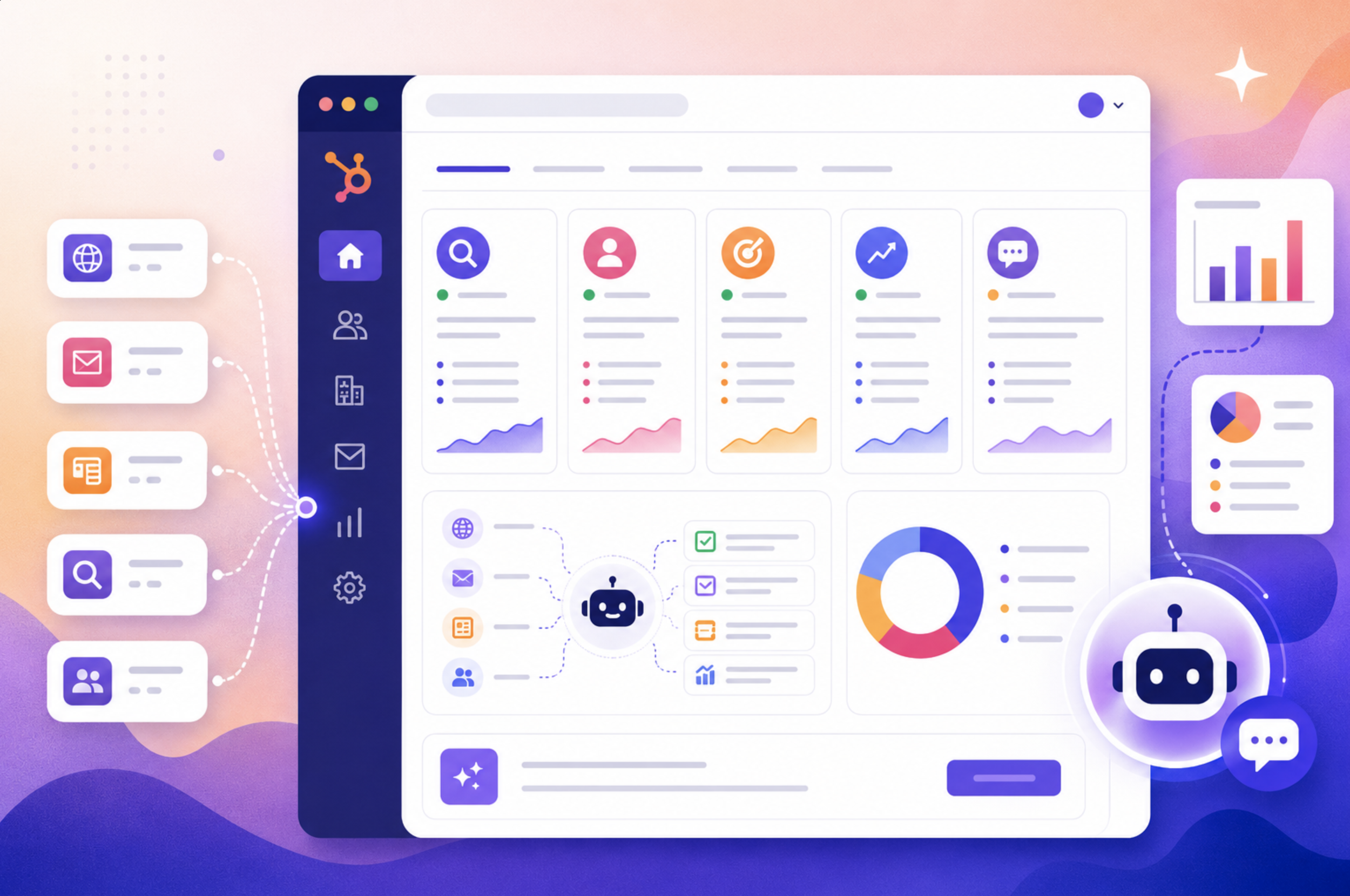
Just a few weeks ago, we published a series on Answer Engine Optimization (AEO) and explored how search is changing in the age of artificial intelligence. As more buyers turn to ChatGPT, Gemini, Claude, and other AI-powered assistants to research solutions, organizations have begun rethinking how they create content and structure their digital presence. The goal is no longer just to rank well in search engines—it’s to become the answer that AI chooses to recommend.
But after spending the past several weeks designing and building AI agents for our own projects and our clients, we’ve come to an interesting realization….
Getting discovered by AI is only half the equation.
The far more interesting question is what happens after someone finds you.
For years, marketing teams have invested heavily in generating traffic. Sales teams have focused on converting that traffic into opportunities. Between those two worlds sat an ever-growing collection of workflows, notifications, spreadsheets, CRM properties, and manual research that required someone to connect the dots. Every company accepted this as simply “how sales works.”
Artificial intelligence is beginning to change that assumption.
Instead of asking people to perform repetitive research and administrative work, organizations can now build intelligent agents that continuously monitor customer signals, gather information, make recommendations, and prepare teams with the context they need before a human ever becomes involved. In many ways, AI agents represent the connective tissue between marketing automation and human decision-making.
That distinction is important because AI agents are often misunderstood. The conversation tends to focus on replacing people, when the reality is much less dramatic—and much more valuable.
The most effective AI agents don’t replace your sales representatives, marketers, or customer success managers. They replace the dozens of small, repetitive tasks that quietly consume their day.
Researching a prospect before a discovery call.
Looking up funding announcements.
Checking ClinicalTrials.gov for pipeline updates.
Reading through email threads before following up on a stalled opportunity.
Finding the right case study to send after someone downloads a whitepaper.
None of those activities create value because they are manual. They create value because they provide context. AI simply removes the time it takes to gather that context.
We’ve been experimenting with exactly this inside HubSpot Enterprise, and one of the biggest surprises has been how approachable the process has become. Building useful AI agents no longer requires an entirely separate AI platform or months of custom software development. With HubSpot’s evolving AI capabilities, Buyer Intent signals, Breeze, Customer Agent, CRM workflows, and integrations with external data sources, it’s becoming possible to create intelligent assistants that work directly inside the systems sales and marketing teams already use every day.
The key is to stop thinking about AI Agents as chatbots. Instead, think of them as specialists.
One agent might behave like a market researcher. Another acts as a sales coordinator. A third functions almost like an account executive’s personal assistant, quietly preparing meeting briefs, summarizing recent customer activity, or identifying opportunities that deserve immediate attention.
One of the more interesting examples we’ve been developing was designed for a pharmaceutical contract development and manufacturing organization (CDMO). Their inside sales team spends a significant amount of time researching prospective biotech companies before determining whether they’re even a good fit for a conversation. That research often requires visiting multiple websites, reviewing clinical trial registries, reading press releases, understanding drug formulations, identifying clinical phases, and evaluating whether a company outsources manufacturing.
It’s valuable work—but it’s also highly repetitive.
Rather than asking every sales representative to repeat the same research process dozens of times each week, we built a specialized research agent. Within seconds, the agent reviews publicly available information, determines whether the company has a specific indication, identifies the most advanced clinical phase, classifies the organization by buyer segment, evaluates its manufacturing footprint, and produces a concise research summary directly inside the CRM.
The salesperson still decides whether to pursue the opportunity. The AI simply arrives first with the homework already completed.
That same philosophy extends well beyond life sciences.
Imagine a prospect visiting several high-intent pages on your website after announcing a new funding round. An AI agent can recognize those two independent signals, connect them together, recommend relevant content based on the prospect's therapeutic area or industry, and notify the appropriate account owner before anyone notices the activity manually.
Or consider an opportunity that’s been sitting in “Proposal Sent” for two weeks without movement. Rather than waiting for someone to remember to check the pipeline, an agent can review recent communications, identify potential objections, suggest involving a technical expert, and recommend the next best action before the opportunity quietly slips away.
These aren’t futuristic concepts anymore. They’re practical workflows that reduce friction across marketing, sales, and customer success.
Perhaps the biggest mindset shift we’ve experienced is realizing that the best AI agents don’t begin with technology. They begin with a question.
“What work do we repeatedly ask our people to do that could be prepared, researched, summarized, or recommended before they even open their laptop?”
Once you start asking that question, opportunities appear everywhere; Meeting preparation, Competitive intelligence, Lead qualification, Content recommendations, Buyer intent analysis, Renewal monitoring, Win-loss analysis, Customer onboarding, and much more.
The list grows surprisingly quickly because every organization has hundreds of small decisions that collectively consume thousands of hours each year.
This is why we believe AI agents represent the natural next chapter after Answer Engine Optimization.
AEO helps buyers discover your organization in an AI-first world. AI agents ensure that every meaningful interaction after that discovery is more relevant, more informed, and more personalized than it could have been through traditional automation alone.
The companies that embrace both won’t simply generate more leads. They’ll create better customer experiences from the very first question a prospect asks an AI assistant to the moment they become a customer—and long after.
At Inveniv, that’s the future we’re most excited about. Not because AI replaces human expertise, but because it gives talented people something they've always wanted more of: time to focus on meaningful conversations instead of repetitive work.